
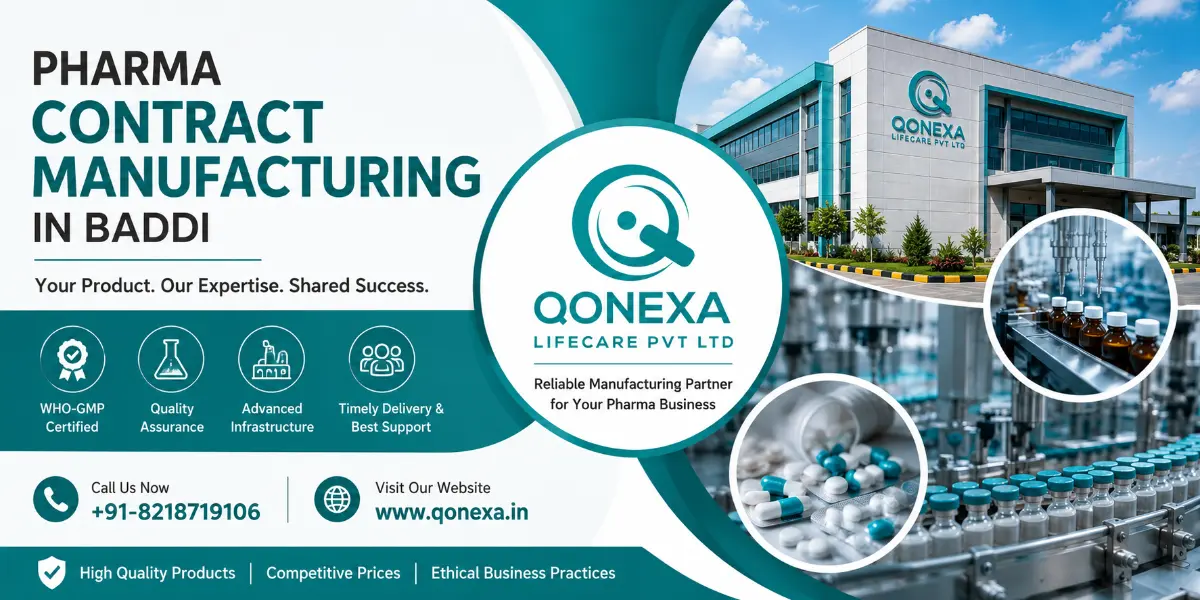
Pharma Contract Manufacturing in Baddi: Complete Guide for Pharmaceutical Businesses
Pharma Contract Manufacturing in Baddi is an important business model for pharmaceutical companies, startups, marketers and entrepreneurs that want to develop and sell pharmaceutical products without establishing and operating their own manufacturing facility.
Under a contract manufacturing arrangement, a company can work with an experienced pharmaceutical manufacturer for the production of selected products according to agreed specifications, quantities, packaging requirements and commercial terms.
This approach can reduce the infrastructure burden for businesses that want to focus primarily on product development, branding, sales, distribution and market expansion.
However, choosing a contract manufacturing partner requires more than comparing product prices. Manufacturing capability, quality systems, documentation, MOQ, production capacity, packaging, testing, timelines and communication all need to be considered before placing an order.
This guide explains the concept of contract manufacturing, the role of Baddi in pharmaceutical manufacturing, the manufacturing process, product categories, cost factors, MOQ, quality considerations, packaging, documentation and the steps businesses should follow before selecting a manufacturing partner.
What Is Pharma Contract Manufacturing?
Pharma contract manufacturing is an arrangement in which one pharmaceutical business engages another pharmaceutical manufacturing organization to produce pharmaceutical products on its behalf.
The business that markets the product may not own the manufacturing facility. Instead, it works with a manufacturing partner that has the relevant production infrastructure and capabilities for the products being considered.
The exact responsibilities of each party depend on the contractual and commercial arrangement.
The manufacturing partner may handle activities associated with production, processing, packaging and quality-related operations, while the client company may focus on product selection, branding, marketing, sales and distribution.
This model can be useful for companies that want to build a pharmaceutical product portfolio without immediately making the investment required to establish an independent manufacturing operation.
Why Is Baddi Considered for Pharmaceutical Manufacturing?
Baddi, located in Himachal Pradesh, is known for its pharmaceutical and industrial manufacturing ecosystem. The region has developed into an important industrial location with businesses involved in pharmaceutical manufacturing and supporting activities.
For pharmaceutical companies, an established manufacturing ecosystem can provide access to production capabilities, technical professionals, packaging resources, logistics services and other supporting infrastructure.
That does not mean every manufacturer in the region is suitable for every product. A company should always evaluate the specific facility, manufacturing capabilities, applicable documentation, quality systems, production capacity and commercial terms of the individual manufacturer.
Important: Choosing a manufacturer because of location alone is not enough. The actual capabilities and suitability of the individual manufacturing facility should be evaluated before an order is placed.
How Pharma Contract Manufacturing Works
The contract manufacturing process normally begins with identifying the products that the client company wants to manufacture.
The company provides relevant product specifications to potential manufacturers. The manufacturer then evaluates the requirement based on its capabilities, production process, raw materials, packaging and other factors.
After discussions regarding quantity, MOQ, packaging, pricing, testing and timelines, the parties can finalize the manufacturing arrangement.
A typical process may include the following stages:
- Product requirement identification.
- Product and formulation discussion.
- Manufacturer capability evaluation.
- Quotation and MOQ discussion.
- Packaging selection.
- Artwork discussion and approval.
- Documentation review.
- Commercial confirmation.
- Production planning.
- Manufacturing and applicable quality checks.
- Packaging and batch completion.
- Dispatch according to agreed terms.
Contract Manufacturing vs Third Party Manufacturing
The terms contract manufacturing and third-party manufacturing are often used in similar business contexts. The exact commercial and legal structure can differ between companies and arrangements.
In practical pharmaceutical business discussions, both models generally involve outsourcing production to a manufacturing partner instead of operating an in-house production facility.
Businesses should focus less on terminology and more on clearly documenting responsibilities, product specifications, quality expectations, pricing, quantities, documentation and delivery terms.
Products That Can Be Considered for Contract Manufacturing
The products available for contract manufacturing depend on the capabilities and approvals of the individual manufacturing facility.
Depending on the facility, businesses may explore categories such as:
- Pharmaceutical tablets.
- Capsules.
- Hard gelatin capsules.
- Softgel capsules.
- Syrups.
- Dry syrups.
- Oral liquid formulations.
- Powder formulations.
- Selected topical formulations.
- Nutraceutical products where applicable.
- Other dosage forms supported by the manufacturing facility.
It is important to confirm whether a particular manufacturer has the infrastructure and applicable capabilities for the exact product category before finalizing the project.
Tablet Contract Manufacturing
Tablets are one of the most common dosage forms considered by pharmaceutical businesses.
Depending on the formulation, tablet production may involve dispensing, blending, granulation, compression, coating, inspection, testing and packaging.
The actual process depends on the product formulation and manufacturing requirements.
When requesting a quotation, the client should provide the product name, composition, strength, pack size, quantity and packaging requirements as clearly as possible.
Capsule Contract Manufacturing
Capsule products can also be considered for outsourced pharmaceutical manufacturing where the manufacturing facility supports the required dosage form.
Pricing can vary according to the active ingredients, strength, fill weight, capsule size, formulation, packaging and order quantity.
Businesses should confirm manufacturing capacity, MOQ, testing requirements and packaging options before finalizing a capsule product.
Syrup Contract Manufacturing
Syrups and oral liquids require manufacturing and packaging processes that differ from solid dosage forms.
Factors such as formulation, fill volume, bottle type, flavouring requirements, packaging and testing can affect the manufacturing arrangement.
The client should provide accurate product specifications before requesting a final quotation.
Key Benefits of Contract Manufacturing
1. Lower Infrastructure Requirement
A company does not necessarily need to establish its own pharmaceutical production facility when it uses an appropriate manufacturing partner.
This can reduce the infrastructure burden associated with machinery, production areas, utilities and manufacturing operations.
2. Focus on Sales and Marketing
One of the major reasons businesses outsource manufacturing is to concentrate on commercial activities.
The company can invest more attention in brand development, sales teams, distribution networks and customer relationships.
3. Product Portfolio Expansion
Contract manufacturing can allow companies to explore additional pharmaceutical products without establishing dedicated manufacturing lines for each category.
4. Access to Manufacturing Expertise
An experienced manufacturer may already have technical teams, production systems and quality-control processes relevant to the products being manufactured.
5. Business Scalability
When a product gains market demand, the company can discuss higher production quantities with the manufacturing partner, subject to available capacity and commercial terms.
6. Reduced Operational Complexity
Managing an independent manufacturing facility involves multiple operational responsibilities. Outsourcing can reduce some of that complexity for a brand owner.
Factors That Influence Pharma Contract Manufacturing Cost
There is no universal price for pharmaceutical contract manufacturing. The final quotation depends on the exact product and commercial requirements.
| Factor | Potential Impact on Cost |
|---|---|
| Active Ingredients | API and other ingredient prices can significantly influence the product cost. |
| Formulation | Different formulations require different production processes and materials. |
| Strength | Different strengths may require different quantities of active and inactive ingredients. |
| Dosage Form | Tablets, capsules, liquids and other dosage forms have different manufacturing requirements. |
| Batch Quantity | Production quantity can influence manufacturing economics. |
| Packaging | Bottles, strips, blisters, cartons, labels and other packaging materials affect cost. |
| Testing | Applicable quality testing contributes to the overall manufacturing arrangement. |
| Artwork | Custom printing and packaging requirements can affect the final quotation. |
| Logistics | Transportation and delivery arrangements can influence the total landed cost. |
Why Fixed Manufacturing Prices Can Be Misleading
Businesses sometimes search for a single fixed manufacturing rate online. This approach can create unrealistic expectations.
Two products with the same dosage form can have completely different costs because their active ingredients, strengths, packaging and batch quantities may be different.
For example, a basic tablet formulation and a formulation containing comparatively expensive active ingredients cannot reasonably be expected to have the same manufacturing cost.
Therefore, businesses should request product-specific quotations instead of relying on generic price lists.
Understanding MOQ in Contract Manufacturing
MOQ means Minimum Order Quantity. It is an important commercial factor in pharmaceutical manufacturing.
The applicable MOQ may vary depending on product type, formulation, batch size, packaging material, production process and the manufacturer's commercial policy.
A new pharmaceutical business may prefer a manageable MOQ while an established company may require larger production volumes.
Before placing an order, confirm whether MOQ applies per product, per strength, per batch or per packaging configuration.
Packaging Requirements
Pharmaceutical packaging protects the product and also communicates important information to the end user.
Depending on the dosage form, packaging can include:
- Blister packs.
- Aluminium strips.
- Bottles.
- Cartons.
- Labels.
- Leaflets where applicable.
- Outer shipping cartons.
The packaging format should be discussed before the quotation is finalized because packaging materials can affect the overall product cost.
Importance of Pharmaceutical Artwork
Artwork is an important part of product development and packaging.
The artwork may contain information such as product name, composition, strength, pack size, manufacturing information, batch details and other applicable information.
Before printing, the artwork should be reviewed carefully to reduce the possibility of avoidable errors.
Businesses should also establish clearly who will prepare, review and approve the final artwork.
Quality Control in Contract Manufacturing
Quality is one of the most important areas to consider when selecting a manufacturing partner.
The manufacturing facility should have appropriate systems for the products it manufactures and should operate according to applicable requirements.
Depending on the product and manufacturing process, quality activities can involve raw-material checks, in-process controls, finished-product testing and batch documentation.
A client should ask what quality documentation is available for the manufactured batch and what testing is applicable to the specific product.
Documents to Review Before Starting Manufacturing
The exact documentation required can vary according to the product, manufacturing arrangement and applicable regulatory requirements.
Depending on the project, businesses may need to review or maintain documentation such as:
- Applicable manufacturing licence information.
- Product specifications.
- Manufacturing agreement.
- Purchase order.
- Quotation.
- Packaging specifications.
- Artwork approvals.
- Applicable testing documentation.
- Quality-related records.
Businesses should verify documentation rather than relying solely on screenshots or informal claims.
How to Select a Contract Manufacturing Company in Baddi
Check Product Capability
The first question should be whether the manufacturer can actually manufacture your required product and dosage form.
Review Quality Systems
Understand the manufacturer's quality-control approach and documentation practices.
Check Production Capacity
If you expect your business to grow, discuss whether the manufacturer can support higher volumes in the future.
Understand MOQ
Confirm the minimum quantity before making commercial commitments.
Compare Complete Quotations
Do not compare only the basic product rate. Consider packaging, testing, taxes, transportation and other applicable charges.
Discuss Timelines
Ask for an estimated manufacturing and dispatch timeline before confirming the order.
Evaluate Communication
Good communication is important because manufacturing involves coordination between product, artwork, packaging, quality and commercial teams.
Questions to Ask Before Choosing a Manufacturer
- Can you manufacture my required dosage form?
- What is the minimum order quantity?
- What product specifications do you require?
- What packaging options are available?
- What is the estimated production timeline?
- What testing is performed?
- What quality documentation is supplied?
- Who will approve the artwork?
- What are the payment terms?
- How is transportation handled?
- Can you support larger quantities in the future?
- How are quality-related complaints handled?
Common Mistakes Businesses Make
Choosing the Cheapest Quote
The cheapest quotation should not automatically be selected. A low price is useful only when the complete manufacturing arrangement meets the required quality and commercial expectations.
Ignoring MOQ
A low per-unit price may not be useful if the required MOQ is too high for your business.
Not Confirming Packaging
Packaging changes can alter the final cost and production timeline.
Not Reviewing Artwork
Errors in packaging information can result in avoidable rework and printing issues.
Not Discussing Lead Time
Manufacturing delays can affect product launches and inventory planning.
Keeping Everything Informal
Important commercial, technical and quality terms should be documented clearly instead of relying entirely on informal conversations.
Contract Manufacturing vs Own Manufacturing Facility
| Factor | Contract Manufacturing | Own Manufacturing Facility |
|---|---|---|
| Infrastructure | Manufacturing infrastructure is provided by the partner. | Company needs to establish its own facility. |
| Machinery | Provided by the manufacturing partner. | Company needs its own production machinery. |
| Technical Operations | Handled through the manufacturing arrangement. | Company manages its own manufacturing operations. |
| Initial Investment | Generally lower infrastructure burden. | Potentially substantially higher. |
| Direct Control | Depends on the manufacturing agreement. | Greater direct control. |
| Operational Responsibility | Lower for the brand owner in many arrangements. | Higher. |
Contract Manufacturing for New Pharma Businesses
For a new pharmaceutical business, establishing a manufacturing plant may not be the most practical first step.
The company may need to spend resources on market research, product selection, branding, sales, distribution and customer acquisition.
A suitable contract manufacturing arrangement can allow the company to outsource production while concentrating on these commercial activities.
However, the business should still conduct appropriate due diligence before selecting a manufacturing partner.
Contract Manufacturing for Established Pharmaceutical Companies
Established pharmaceutical companies may use contract manufacturing for several reasons.
They may need additional production capacity, want to launch new products, require specialized dosage forms or want flexibility in managing production volumes.
Outsourcing can complement an existing manufacturing setup rather than replacing it completely.
Role of Baddi in Pharma Business
The pharmaceutical ecosystem in Baddi makes the region relevant to businesses evaluating manufacturing options.
However, the location should be treated as one factor rather than a guarantee of manufacturing quality or suitability.
Every manufacturing facility should be evaluated independently according to the specific product requirement.
How Qonexa Can Support Pharma Manufacturing Requirements
Qonexa Lifecare Pvt. Ltd. works with businesses exploring pharmaceutical products, manufacturing and pharma business opportunities.
If you are planning to launch your own pharmaceutical products or are evaluating manufacturing options, you can discuss your requirements with the Qonexa team.
For more information about pharmaceutical business and manufacturing solutions, visit Qonexa.in.
For Ayurvedic and herbal product-related information, you can also explore Qonexa Veda.
Looking for Pharma Contract Manufacturing?
Share your product, dosage form, packaging and quantity requirements with Qonexa Lifecare Pvt. Ltd.
Call +91-8218719106Step-by-Step Process to Start Contract Manufacturing
Step 1: Define Your Product Portfolio
Prepare a list of products you want to manufacture. Include composition, strength, dosage form and pack size where possible.
Step 2: Identify Your Target Market
Understand your target customers, sales geography and expected demand.
Step 3: Shortlist Suitable Manufacturers
Identify manufacturers with capabilities that match your product requirements.
Step 4: Request Product-Specific Quotations
Provide complete specifications instead of requesting a generic price list.
Step 5: Compare Commercial Terms
Compare MOQ, product price, packaging, testing, taxes, logistics and payment terms.
Step 6: Finalize Packaging
Confirm packaging format, pack size and artwork requirements.
Step 7: Review Documentation
Verify applicable documentation and manufacturing requirements before production.
Step 8: Confirm the Order
Finalize the commercial arrangement and provide the required purchase order or confirmation.
Step 9: Production
The manufacturing partner proceeds according to the agreed manufacturing requirements.
Step 10: Quality and Dispatch
Applicable quality checks are completed before the finished products are packed and dispatched according to the agreed terms.
How to Control Manufacturing Costs
Cost control should focus on improving efficiency rather than simply selecting the lowest-priced manufacturer.
- Compare multiple product-specific quotations.
- Plan realistic production quantities.
- Discuss packaging alternatives.
- Minimize unnecessary packaging complexity.
- Plan artwork carefully before printing.
- Understand complete landed cost.
- Discuss future volume requirements early.
- Plan production timelines in advance.
Cost optimization should not involve compromising applicable product quality or regulatory requirements.
What Should a Manufacturing Quotation Contain?
A detailed quotation makes comparison easier and reduces the possibility of unexpected costs.
Depending on the product, a quotation may include:
- Product name.
- Composition.
- Strength.
- Pack size.
- Order quantity.
- Per-unit rate.
- Packaging details.
- Applicable taxes.
- Transportation terms.
- Payment terms.
- Estimated delivery timeline.
If any important component is unclear, ask for clarification before confirming the order.
Importance of a Long-Term Manufacturing Relationship
Manufacturing is not always a one-time transaction. Businesses that successfully develop a product may require repeated batches over an extended period.
A reliable manufacturing relationship can make future production planning easier.
At the same time, long-term business should remain supported by clear documentation, consistent quality, transparent commercial terms and reliable communication.
First Order Checklist
✔ Product composition confirmed
✔ Dosage form confirmed
✔ Strength confirmed
✔ Pack size confirmed
✔ Manufacturer capability checked
✔ MOQ confirmed
✔ Product quotation reviewed
✔ Packaging finalized
✔ Artwork checked
✔ Applicable testing discussed
✔ Documentation reviewed
✔ Payment terms confirmed
✔ Delivery timeline discussed
✔ Manufacturing terms documented
Conclusion
Pharma Contract Manufacturing in Baddi can provide a practical route for pharmaceutical companies that want to develop and market products without establishing a complete manufacturing facility of their own.
Baddi's established pharmaceutical and industrial ecosystem makes it a location worth considering when evaluating manufacturing partners. However, the most important decision is not simply choosing Baddi; it is choosing a manufacturing facility that matches the exact requirements of your products.
Businesses should evaluate manufacturing capability, quality systems, documentation, MOQ, production capacity, packaging, testing, pricing and delivery timelines before placing an order.
A properly planned contract manufacturing arrangement can allow pharmaceutical businesses to focus more heavily on branding, marketing, sales and distribution while production is handled by an appropriate manufacturing partner.
The safest approach is to prepare complete product specifications, obtain detailed quotations, verify relevant documentation and clearly document commercial and technical terms before production begins.
Start Your Pharma Manufacturing Discussion
Contact Qonexa Lifecare Pvt. Ltd. to discuss your pharmaceutical product and contract manufacturing requirements.
+91-8218719106Frequently Asked Questions
What is pharma contract manufacturing?
Pharma contract manufacturing is an arrangement where a pharmaceutical business engages another manufacturing organization to produce pharmaceutical products according to agreed product, quality, quantity, packaging and commercial requirements.
Why do pharmaceutical companies use contract manufacturing?
Companies may use contract manufacturing to reduce the infrastructure burden associated with owning a manufacturing facility and to focus more on product development, branding, marketing, sales and distribution.
Why is Baddi considered for pharma contract manufacturing?
Baddi has an established pharmaceutical and industrial ecosystem. Businesses may consider manufacturers in the region based on their product capabilities, infrastructure, quality systems and commercial terms.
What products can be manufactured through contract manufacturing?
Depending on the manufacturing facility, businesses may explore tablets, capsules, syrups, dry syrups, oral liquids, powders, softgels and other dosage forms supported by the facility.
How much does pharma contract manufacturing cost?
There is no single fixed cost. Pricing can depend on formulation, active ingredients, strength, dosage form, quantity, packaging, testing, MOQ, logistics and other commercial factors.
What is MOQ in pharma contract manufacturing?
MOQ means Minimum Order Quantity. The applicable MOQ varies according to product type, dosage form, batch size, packaging requirements and the manufacturer's commercial terms.
How should I choose a contract manufacturer in Baddi?
Evaluate the manufacturer's product capabilities, quality systems, applicable documentation, MOQ, production capacity, packaging options, pricing, timelines and communication before making a decision.
Can startups use pharma contract manufacturing?
Yes. Contract manufacturing can be considered by startups that want to develop pharmaceutical products without immediately establishing their own manufacturing facility, subject to applicable requirements.
How can I contact Qonexa for contract manufacturing?
You can contact Qonexa Lifecare Pvt. Ltd. at +91-8218719106 to discuss your pharmaceutical product and manufacturing requirements.