
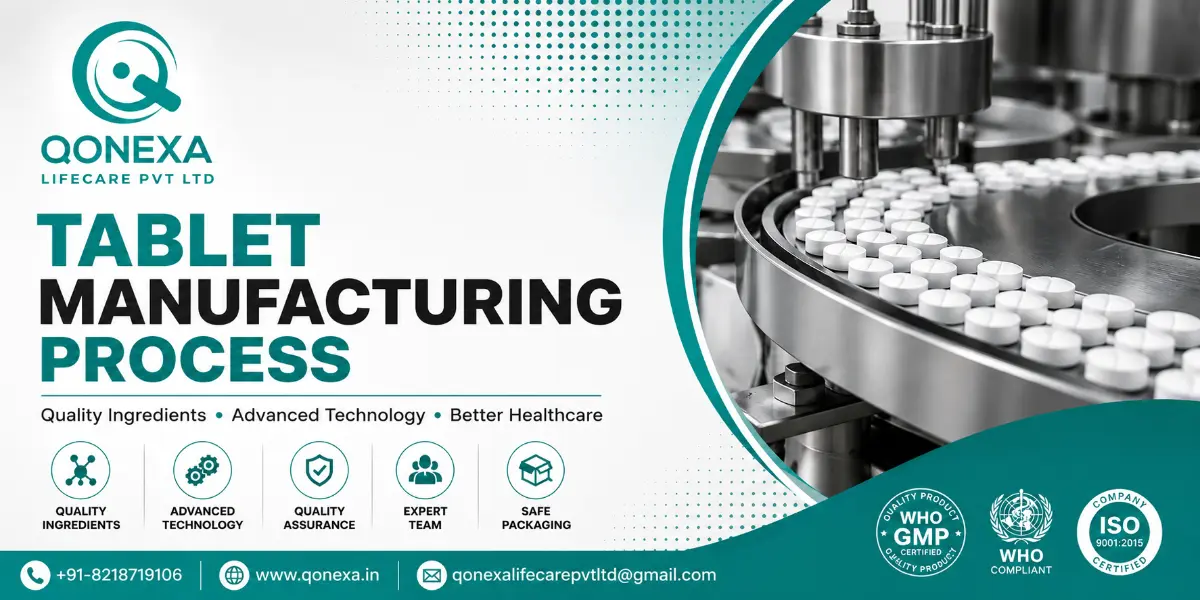
Tablet Manufacturing Process – Complete Guide to Pharma Tablet Manufacturing
Tablet manufacturing process is one of the most important pharmaceutical production systems used across the world. Tablets are among the most commonly prescribed dosage forms because they are convenient, stable, cost-effective and easy to administer.
In the pharmaceutical industry, the tablet manufacturing process involves multiple stages including raw material dispensing, granulation, blending, compression, coating, quality testing and packaging. Every step is carefully controlled to ensure product quality, safety and consistency.
Whether you are a pharmaceutical entrepreneur, pharma franchise partner, pharmacy student or healthcare professional, understanding how tablets are manufactured can help you better understand pharmaceutical production standards.
In this complete guide, we will explain every stage of the tablet manufacturing process, quality control requirements, equipment used and pharmaceutical manufacturing best practices.
What is Tablet Manufacturing?
Tablet manufacturing is the pharmaceutical process of converting active pharmaceutical ingredients (APIs) and excipients into compressed solid dosage forms known as tablets.
The process requires precise formulation development, controlled manufacturing conditions and strict quality assurance systems.
Why Tablets are Popular
- Easy administration
- Accurate dosing
- Long shelf life
- Cost-effective production
- Convenient packaging
- High patient compliance
These advantages make tablets one of the most widely used pharmaceutical dosage forms worldwide.
Importance of the Tablet Manufacturing Process
The tablet manufacturing process directly impacts the quality, safety and effectiveness of pharmaceutical products.
Improper manufacturing can affect tablet hardness, dissolution, stability and overall product performance.
Key Objectives
- Uniform drug distribution
- Consistent tablet weight
- Proper hardness
- Correct dissolution profile
- Quality assurance
- Regulatory compliance
This is why pharmaceutical companies invest heavily in modern manufacturing systems and quality controls.
Major Stages of Tablet Manufacturing Process
| Stage | Purpose |
|---|---|
| Dispensing | Raw Material Weighing |
| Granulation | Particle Improvement |
| Drying | Moisture Reduction |
| Blending | Uniform Mixing |
| Compression | Tablet Formation |
| Coating | Protection & Appearance |
| Packaging | Final Product Packing |
Step 1: Raw Material Dispensing
The first stage of the tablet manufacturing process begins with dispensing raw materials.
Active pharmaceutical ingredients and excipients are weighed according to approved batch manufacturing records.
Materials Used
- Active Pharmaceutical Ingredients (API)
- Binders
- Diluents
- Disintegrants
- Lubricants
- Coating Materials
Accurate dispensing is critical because even minor weighing errors can affect the final product quality.
Step 2: Granulation Process
Granulation is one of the most important stages in the tablet manufacturing process. It improves powder flow properties and ensures uniform drug distribution.
Types of Granulation
- Wet Granulation
- Dry Granulation
- Direct Compression
Wet Granulation
In wet granulation, powders are mixed with a binder solution to form granules. These granules improve compressibility and tablet quality.
Dry Granulation
Dry granulation is used when ingredients are sensitive to moisture or heat.
Direct Compression
Some formulations can be compressed directly without granulation when powder flow characteristics are suitable.
Step 3: Drying Process
After wet granulation, moisture must be removed from granules.
Drying helps achieve optimal moisture levels and improves product stability.
Common Drying Equipment
- Fluid Bed Dryer (FBD)
- Tray Dryer
- Vacuum Dryer
Moisture levels are carefully monitored because excess moisture can affect tablet quality.
Step 4: Blending and Lubrication
Once granules are dried, they are blended with lubricants and other excipients.
The purpose of blending is to ensure uniform distribution of all formulation components.
Benefits of Proper Blending
- Uniform Dosage
- Better Flow Properties
- Consistent Compression
- Improved Product Quality
Blending plays a critical role in maintaining consistency throughout the tablet manufacturing process.
Step 5: Tablet Compression Process
Tablet compression is the core stage of the tablet manufacturing process. During this step, blended granules are compressed into tablets using specialized tablet compression machines.
The objective is to produce tablets with consistent weight, hardness, thickness and drug content.
Compression Parameters
- Tablet Weight
- Hardness
- Thickness
- Compression Force
- Disintegration Time
Modern pharmaceutical facilities use advanced compression machines to ensure batch-to-batch consistency.
Step 6: Tablet Coating Process
After compression, some tablets undergo coating depending on product requirements.
Coating improves appearance, protects the tablet from moisture and can help control drug release.
Types of Tablet Coating
- Film Coating
- Sugar Coating
- Enteric Coating
- Modified Release Coating
Film coating is one of the most widely used methods in modern pharmaceutical manufacturing.
Step 7: Quality Control Testing
Quality control is an essential part of the tablet manufacturing process. Every batch must undergo testing before market release.
Important Quality Tests
- Weight Variation Test
- Hardness Test
- Friability Test
- Disintegration Test
- Dissolution Test
- Assay Test
- Content Uniformity Test
These tests ensure that pharmaceutical tablets meet required quality specifications.
Step 8: Blister Packing and Final Packaging
Once quality approval is completed, tablets move to the packaging stage.
Packaging protects products from environmental conditions and ensures product integrity throughout the supply chain.
Common Packaging Types
- Alu-Alu Blister Packs
- Alu-PVC Blister Packs
- Strip Packaging
- HDPE Containers
Proper packaging contributes significantly to product stability and shelf life.
Equipment Used in Tablet Manufacturing Process
| Equipment | Function |
|---|---|
| Rapid Mixer Granulator | Granulation |
| Fluid Bed Dryer | Drying |
| Multi Mill | Size Reduction |
| Octagonal Blender | Mixing |
| Compression Machine | Tablet Formation |
| Coating Pan | Tablet Coating |
| Blister Packing Machine | Packaging |
WHO-GMP Standards in Tablet Manufacturing
WHO-GMP guidelines play a major role in maintaining pharmaceutical manufacturing quality.
Every stage of the tablet manufacturing process must be documented, monitored and validated according to established quality systems.
WHO-GMP Focus Areas
- Documentation
- Personnel Training
- Equipment Validation
- Process Control
- Quality Assurance
- Hygiene Standards
Compliance with WHO-GMP standards helps maintain product quality and regulatory confidence.
Common Challenges in Tablet Manufacturing
- Capping
- Lamination
- Weight Variation
- Picking and Sticking
- Hardness Variations
- Dissolution Failures
Modern manufacturing technologies and strong quality systems help minimize these challenges.
Why Choose Qonexa Lifecare for Tablet Manufacturing?
Qonexa Lifecare offers quality-focused pharmaceutical manufacturing solutions backed by professional production standards and WHO-GMP compliant systems.
Our Strengths
- WHO-GMP Manufacturing Standards
- Advanced Production Facilities
- Quality Assurance Systems
- Wide Product Portfolio
- Third Party Manufacturing Support
- PCD Pharma Franchise Opportunities
- Timely Delivery Across India
Useful Links
Frequently Asked Questions
Conclusion
The tablet manufacturing process is a highly controlled pharmaceutical production system that ensures tablets meet required standards for safety, quality and effectiveness. From dispensing and granulation to compression, coating and packaging, every stage contributes to product performance.
Understanding the complete tablet manufacturing process helps pharmaceutical professionals, entrepreneurs and healthcare businesses appreciate the science and quality systems behind modern medicine manufacturing.
Explore Ayurvedic Manufacturing with Qonexa Veda
Businesses looking for Ayurvedic and herbal product manufacturing solutions can also explore Qonexa Veda. The company focuses on Ayurvedic third party manufacturing, herbal formulations, Ayurvedic tablets, syrups, capsules and franchise opportunities across India.
Qonexa Veda is committed to quality-focused manufacturing practices and offers a wide range of Ayurvedic products designed to meet modern healthcare requirements.
Visit Qonexa Veda