
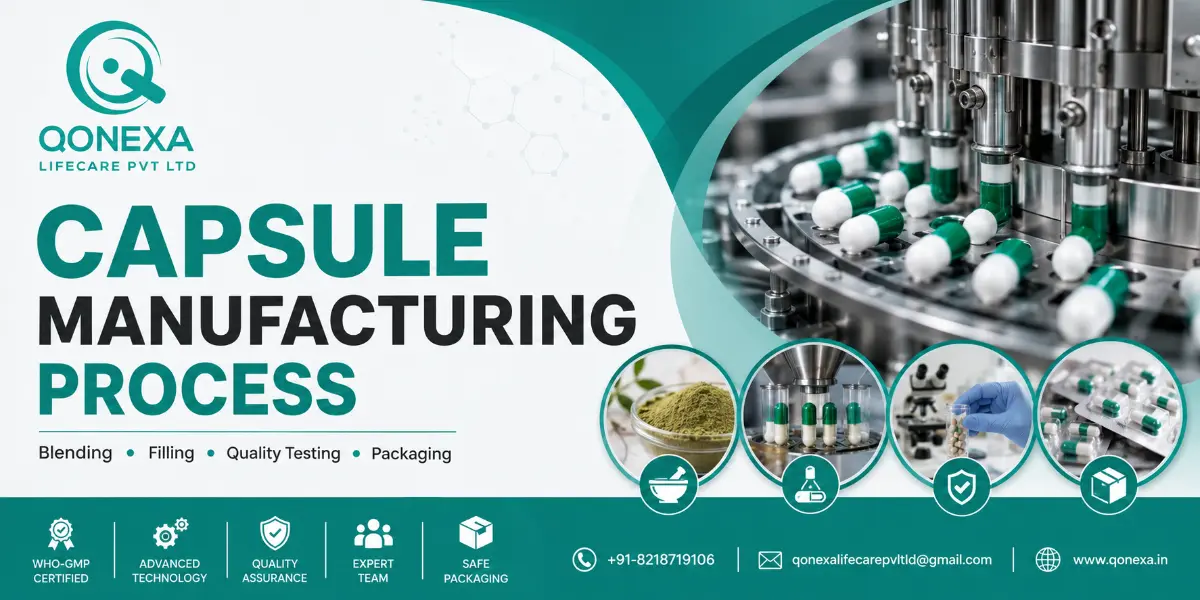
Capsule Manufacturing Process – Complete Guide to Pharmaceutical Capsule Production
Capsule manufacturing process is one of the most widely used pharmaceutical production methods for delivering medicines in a convenient and effective dosage form. Capsules are preferred by patients because they are easy to swallow, mask unpleasant tastes and provide accurate dosing.
The pharmaceutical capsule manufacturing process involves formulation development, blending, capsule filling, sealing, quality testing and packaging.
Modern capsule manufacturing facilities follow WHO-GMP standards to ensure product quality, safety and consistency.
In this guide, we will explain the complete capsule manufacturing process, equipment used, quality control procedures and pharmaceutical manufacturing best practices.
What is Capsule Manufacturing?
Capsule manufacturing is the pharmaceutical process of filling active pharmaceutical ingredients and excipients into hard gelatin or vegetarian capsules.
Advantages of Pharmaceutical Capsules
- Easy to swallow
- Accurate dosage
- Improved patient compliance
- Taste masking
- Fast disintegration
- Convenient packaging
Importance of Capsule Manufacturing Process
The capsule manufacturing process plays a crucial role in ensuring medicine quality, dosage accuracy and product stability.
Any variation during manufacturing can affect capsule weight, content uniformity and therapeutic effectiveness.
Main Objectives
- Uniform drug distribution
- Accurate capsule filling
- Product stability
- Quality assurance
- Regulatory compliance
- Patient safety
Types of Pharmaceutical Capsules
| Capsule Type | Description |
|---|---|
| Hard Gelatin Capsules | Most common pharmaceutical capsules |
| Vegetarian Capsules | Plant-based capsule shells |
| Softgel Capsules | Liquid or semi-solid filled capsules |
Major Stages of Capsule Manufacturing Process
| Stage | Purpose |
|---|---|
| Raw Material Dispensing | Accurate weighing |
| Blending | Uniform mixing |
| Capsule Filling | Dose filling |
| Capsule Locking | Sealing capsules |
| Quality Testing | Product verification |
| Packaging | Final packing |
Step 1: Raw Material Dispensing
The first stage of the capsule manufacturing process begins with dispensing raw materials.
All active pharmaceutical ingredients and excipients are weighed according to approved batch manufacturing records.
Materials Used
- Active Pharmaceutical Ingredients (API)
- Diluents
- Disintegrants
- Lubricants
- Glidants
- Capsule Shells
Step 2: Blending Process
Blending ensures uniform distribution of active ingredients throughout the formulation.
Proper blending is essential to maintain dosage consistency and product quality.
Benefits of Blending
- Uniform drug distribution
- Improved flow properties
- Consistent filling
- Enhanced product quality
Step 3: Capsule Filling Process
After blending, the formulation is transferred to capsule filling machines.
Automated equipment fills each capsule with a precise quantity of powder or granules.
Advantages of Automated Filling
- Accurate dosing
- Higher productivity
- Reduced wastage
- Consistent quality
Step 4: Capsule Locking and Sealing
After filling, capsules are locked securely to prevent leakage and maintain product integrity. Proper locking is an essential stage of the capsule manufacturing process.
Benefits of Capsule Locking
- Prevents product loss
- Improves stability
- Enhances product safety
- Maintains dosage accuracy
Step 5: Quality Control Testing
Every batch produced during the capsule manufacturing process undergoes rigorous quality testing before release.
Important Quality Tests
- Weight Variation Test
- Disintegration Test
- Dissolution Test
- Assay Test
- Content Uniformity Test
- Moisture Content Test
- Microbial Testing
These tests help ensure pharmaceutical capsules meet quality and regulatory requirements.
Step 6: Packaging Process
After approval from the quality department, capsules move to packaging.
Packaging Options
- Alu-Alu Blister Packs
- Alu-PVC Blister Packs
- HDPE Containers
- Strip Packaging
Proper packaging protects capsules from moisture, heat and environmental exposure.
Equipment Used in Capsule Manufacturing Process
| Equipment | Function |
|---|---|
| Octagonal Blender | Uniform blending |
| Capsule Filling Machine | Capsule filling |
| Capsule Polishing Machine | Cleaning capsules |
| Metal Detector | Safety inspection |
| Blister Packing Machine | Packaging |
| Labelling Machine | Product labelling |
WHO-GMP Standards in Capsule Manufacturing
WHO-GMP guidelines help maintain consistency and product quality throughout the capsule manufacturing process.
WHO-GMP Focus Areas
- Documentation Control
- Personnel Training
- Equipment Validation
- Quality Assurance
- Process Validation
- Hygiene Standards
Following WHO-GMP requirements helps pharmaceutical companies build trust and ensure regulatory compliance.
Common Challenges in Capsule Manufacturing
- Weight Variation
- Poor Flow Properties
- Capsule Breakage
- Moisture Sensitivity
- Content Uniformity Issues
- Packaging Defects
Modern production systems and quality control procedures help minimize these challenges.
Why Choose Qonexa Lifecare for Capsule Manufacturing?
Qonexa Lifecare provides quality-focused pharmaceutical manufacturing solutions backed by professional infrastructure and WHO-GMP compliant systems.
Our Strengths
- WHO-GMP Manufacturing Standards
- Advanced Production Facilities
- Quality Assurance Systems
- Third Party Manufacturing Support
- Wide Product Portfolio
- PCD Pharma Franchise Opportunities
- Pan India Business Network
Explore Ayurvedic Manufacturing with Qonexa Veda
For Ayurvedic and herbal manufacturing solutions, businesses can also explore Qonexa Veda.
Qonexa Veda specializes in Ayurvedic third party manufacturing, herbal capsules, syrups, tablets and franchise opportunities across India.
Useful Links
Frequently Asked Questions
Conclusion
The capsule manufacturing process is a highly controlled pharmaceutical production system that ensures safe, effective and high-quality medicines. Every stage, from dispensing and blending to filling, testing and packaging, plays an important role in maintaining product quality.
Understanding the complete capsule manufacturing process helps pharmaceutical professionals, entrepreneurs and healthcare businesses appreciate the science and quality standards behind modern capsule manufacturing.