
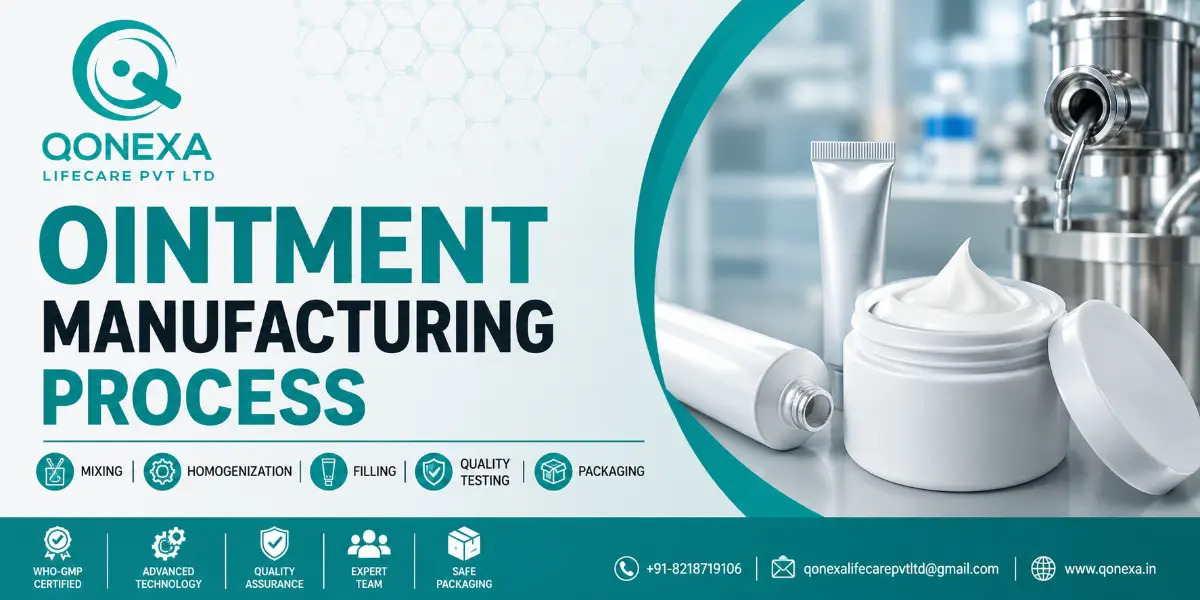
Ointment Manufacturing Process – Complete Guide to Pharmaceutical Ointment Production
The ointment manufacturing process is an important pharmaceutical production method used to manufacture topical medicines for skin application. Ointments are widely used for dermatological treatments, pain relief products and medicated skin care formulations.
A well-controlled production system ensures product stability, uniformity and therapeutic effectiveness. Modern pharmaceutical facilities follow WHO-GMP guidelines to maintain quality standards throughout manufacturing.
In this guide, we explain the complete ointment manufacturing process, equipment used, quality requirements and industry best practices.
What is Ointment Manufacturing?
Ointment manufacturing is the process of preparing semi-solid pharmaceutical formulations by blending active ingredients with suitable ointment bases.
Advantages of Ointments
- Easy topical application
- Localized drug delivery
- Improved skin absorption
- Long-lasting effect
- Reduced systemic side effects
- Better patient compliance
Importance of Pharmaceutical Ointment Production
The ointment manufacturing process helps ensure uniform drug distribution and consistent product quality.
Proper manufacturing controls improve stability, texture, spreadability and overall effectiveness of topical formulations.
Main Objectives
- Uniform drug distribution
- Product stability
- Quality assurance
- Patient safety
- Regulatory compliance
- Batch consistency
Common Types of Ointments
| Type | Application |
|---|---|
| Antibiotic Ointments | Skin infections |
| Antifungal Ointments | Fungal infections |
| Pain Relief Ointments | Muscle and joint pain |
| Steroid Ointments | Inflammatory skin conditions |
| Herbal Ointments | Natural skin care applications |
Major Stages of Manufacturing
| Stage | Purpose |
|---|---|
| Raw Material Dispensing | Accurate weighing |
| Base Preparation | Ointment base creation |
| Ingredient Mixing | Uniform blending |
| Homogenization | Smooth consistency |
| Filling | Tube or container filling |
| Quality Testing | Product verification |
| Packaging | Final packing |
Step 1: Raw Material Dispensing
The first stage of the ointment manufacturing process involves dispensing active ingredients, excipients and ointment bases according to approved batch records.
Materials Commonly Used
- Active Pharmaceutical Ingredients (API)
- Petroleum Jelly
- Paraffin
- Lanolin
- Emulsifiers
- Preservatives
- Purified Water
Step 2: Ointment Base Preparation
The selected base ingredients are melted and blended under controlled temperature conditions to achieve a uniform base.
This stage plays a major role in determining the texture, stability and spreadability of the final product.
Benefits of Proper Base Preparation
- Consistent texture
- Improved stability
- Better appearance
- Enhanced product performance
Step 3: Mixing of Active Ingredients
Active ingredients are incorporated into the prepared base using controlled mixing equipment.
The goal is to achieve uniform distribution throughout the formulation without affecting product stability.
Key Considerations
- Uniform blending
- Temperature control
- Mixing speed monitoring
- Ingredient compatibility
Step 4: Homogenization Process
Homogenization is performed to achieve a smooth and uniform consistency throughout the formulation. This stage helps improve texture, stability and appearance.
Benefits of Homogenization
- Uniform drug distribution
- Smooth texture
- Improved stability
- Enhanced product quality
Step 5: Filling Process
After homogenization, the finished formulation is transferred to filling machines where it is packed into tubes, jars or containers under controlled conditions.
Packaging Options
- Aluminium Tubes
- Laminated Tubes
- Plastic Containers
- Pharmaceutical Jars
Step 6: Quality Control Testing
Every batch undergoes detailed quality testing before market release.
Important Quality Tests
- Appearance Test
- pH Testing
- Viscosity Testing
- Assay Testing
- Microbial Testing
- Stability Testing
- Content Uniformity Testing
Equipment Used in Ointment Manufacturing
| Equipment | Function |
|---|---|
| Melting Vessel | Base preparation |
| Mixing Tank | Ingredient blending |
| Homogenizer | Smooth consistency |
| Storage Tank | Product holding |
| Tube Filling Machine | Product filling |
| Sealing Machine | Tube sealing |
| Packaging Machine | Final packaging |
WHO-GMP Standards for Ointment Production
WHO-GMP compliance helps manufacturers maintain high quality standards and ensure safe pharmaceutical products.
Key Requirements
- Process Validation
- Equipment Qualification
- Personnel Training
- Quality Assurance Systems
- Documentation Control
- Hygiene Standards
Common Manufacturing Challenges
- Phase Separation
- Texture Variations
- Microbial Contamination
- Incorrect Viscosity
- Packaging Defects
- Stability Issues
Modern production systems help minimize these challenges and improve batch consistency.
Why Choose Qonexa Lifecare?
Qonexa Lifecare offers high-quality pharmaceutical manufacturing solutions supported by modern infrastructure and strict quality systems.
Our Strengths
- WHO-GMP Manufacturing Standards
- Advanced Production Facilities
- Experienced Quality Team
- Third Party Manufacturing Support
- Wide Product Portfolio
- PCD Pharma Franchise Opportunities
- Pan India Business Network
📞 +91-8218719106
📧 qonexalifecarepvtltd@gmail.com
Explore Ayurvedic Manufacturing with Qonexa Veda
Businesses looking for Ayurvedic and herbal manufacturing solutions can also explore Qonexa Veda.
Qonexa Veda specializes in Ayurvedic products, herbal formulations, third party manufacturing and franchise opportunities across India.
Useful Internal Links
Frequently Asked Questions
Conclusion
The ointment manufacturing process involves multiple controlled stages including base preparation, mixing, homogenization, filling and quality testing. Proper manufacturing practices help ensure safe, stable and effective pharmaceutical products.
Understanding the complete production workflow helps pharmaceutical businesses maintain quality standards and meet regulatory requirements while delivering reliable topical medicines.